(Photo: Larry Lytle)
Thirty years ago I was a clueless kid digging holes in the badlands of Southern California's suburban outback. Flattened by roving backhoes and moto-graders, it was in the midst of this sun-bleached terrain that I hoped to unearth specimens of some unimaginable importance. It wasn't just the idea of unearthing, it was also the prospect of somehow reanimating these animals that had long been dead – somehow re-situating them in fantastic primordial scenes. At an early age I was fascinated with prehistoric life and the mysteries of evolution, and while my plastic shovel didn't uncover any significant fossils, it later became the foundation for my artistic explorations.
Over the past several years I have developed a body of work that seeks to generate a dialogue between art and science. Many artists have explored this terrain, but the dialogue I have generated, as well as the resulting artworks are far from conventional. At a core level, my work addresses the nature of colonized space – orders that have come undone, as well as orders that have been artificially manufactured (or manu-fractured) with the passage of time.
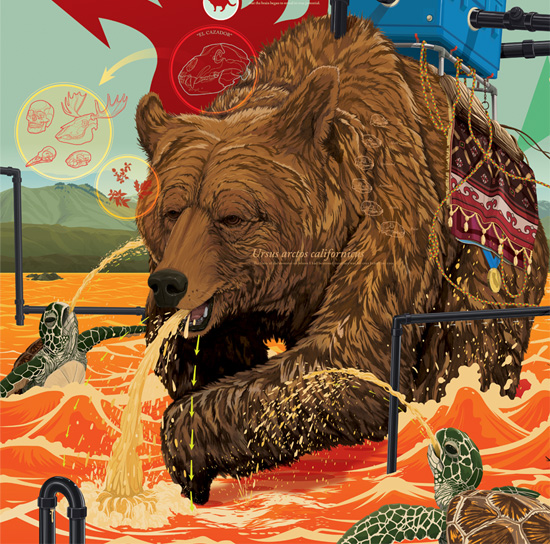
The goal in this work is to provide a hybrid glimpse that directly juxtaposes both natural and unnatural histories. While the larger works evoke the grand scale and tradition of natural history museum dioramas, smaller intricately rendered pieces reflect 18th Century desires to chronicle oddities of the known world. Unlike typical museum settings which focus on strict empirical evidence, my work meshes both current and defunct scientific research, often sourced from outdated textbooks and mid-20th Century "pulp science" pocketbooks and paperbacks. My work is influenced by those "messier" accounts we sometimes encounter: the pack of coyotes taking up residence in a foreclosed suburban home, a pair of sweatpants discovered amidst the stomach contents of a beached whale, a mountain lion wandering the early morning lanes of an interstate freeway.
The resulting artworks act as homespun hypotheses
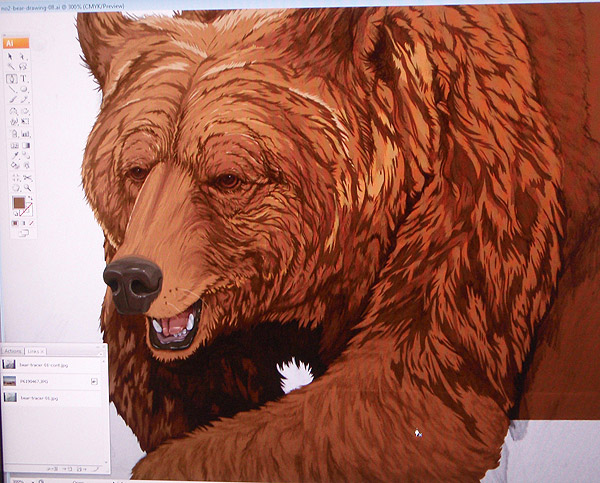
containing elements that are mashed up and cobbled together. In this sense, it is typical to find a mixture of otherwise mundane objects exalted in museum-like settings. Traffic cones, vacuum cleaners, Igloo coolers, and aluminum lawn chairs populate these works alongside bighorn sheep, extinct grizzly bears, raccoons, and an array of diverse ecological inhabitants. Yet despite the seeming chaos, examining the encroachment of these synthetic artifacts, as well as the distinctly human impacts on the environment, might present the most faithful account of what has become the "natural" world. This is nature – including human nature.
In this work the prehistoric and the present, as well as the natural and the unnatural, have all become one. The results are unfiltered. At times the superimposed and mismatched elements reach a fervent pitch, and the effect is reminiscent of misaligned transparencies or perhaps some sort of ornately vandalized textbooks.
There is a nod to the erratic displays of pre-Enlightenment curiosity cabinets, colonialism and manifest destiny, but all of this has the look of a natural history museum crossed with a Home Depot. In the end, I hope this work will somehow point to a broader intersection of culture and science, while attempting to explore the baffling and changing realities of our world.
|